
On the waterfront
- Meher Marfatia

- Feb 7
- 7 min read
Updated: Feb 23
Ten jewel-like buildings at Apollo Bunder have offered more than simply great harbour views since 1900

Why can I not stop smiling each time I set eyes on the Gateway of India? This enduring symbol, so often taken to define Bombay, has my birth date indelibly carved into its yellow basalt. It was a thrill as a kid to learn this was where the King and Queen of England entered town a century ago on December 2. The ride to Wittet’s triumphal arch, which welcomed the only British monarch to visit Raj India, became an annual affair. Pointing out monuments and milestones en route, my parents made mine the city they had explored as theirs.
Strolling on one of our family-favourite promenades, I seek the stories behind the ten apartment blocks lending the 100-metre axis between the Taj and Radio Club a luminous glow. (Incidentally, Jamsetji Tata’s 1903 magnificent hotel converted into a 600-bed hospital during World War I.)
With large windows overlooking the misty Uran horizon hills, these buildings rose at the dawn of the 1900s along Apollo Bunder or Strand Road. Rechristened Prem Ramchandani Marg to honour the braveheart fatally hit flying a Mystere in the 1965 Indo-Pak War. The motto of Sindh-born Ramchandani, just 7 years old when his family experienced Partition, was: “I regret I have but one life to give for my country.”

Apollo Bunder proved the Bombay Port Trust’s finest reclamation scheme leasing 99-year estates. Bunder meaning “port”, the word Apollo is supposed to derive from the Palla fish sold at the spot – corrupted to the Portuguese “Pollem”, it finally emerged as “Apollo”. Another version sourced from Marathi books on Bombay has it that Apollo is an adaptation of Palava, a fishing vessel in Bombay waters – “Palava la jaavu ya” was “Let’s go fishing.”
The gem kicking off the Edwardian-Art Deco stretch is Northcote Nursing Home, constructed in 1902. Named for Lord Northcote, Governor of Bombay from 1900 to 1903, this English guesthouse was converted into a multi-specialty facility by one Mr Adenwala. Plastic surgeon Dr Sam Mahaluxmivala joined in 1961, tending trauma and cosmetic cases. “Celebrities would register under assumed names, most commonly Shah,” he laughs. His huge contribution is Northcote’s art collection: every room and landing boasted canvases by KH Ara, Shiavax Chavda, Homi Patel and Lalitha Lajmi among others.
When the nursing home closed in 2007, the works were raffled. Though not part of the Northcote collection, an interesting painting personally acquired in 1968 by Dr Mahaluxmivala hangs in the living room of his home – MF Husain’s “Beginning of a Kathakali” – one of just three 6 x 4-feet canvases that the master artist signed in Malayalam.
Next up, The Anchorage, recipient of the 1989 Heritage Society Award, has royal links. The family of Rajkumari Urmila Devi of Kotda Sangani, daughter of Vijaya Devi, Princess of Mysore, owned the building, where Urmila Devi was born in January 1947. “Through the ’30s, this was the winter home of my grandfather, the Yuvaraja of Mysore, Kanteerava Narasimharaja Wadiyar, younger brother of Maharaja Krishnaraja Wadiyar IV who ruled from 1902,” she says in a phone conversation. “Mother loved visiting The Anchorage. My grandmother, the Yuvarani of Mysore, from a relatively landlocked state, enjoyed the sea and shopping for silver in the vicinity.” The princesses’ favourite song those days was “Ramona” which they blasted on their gramophone. In 1940, the Yuvaraja returned unwell from a foreign trip to The Anchorage, where he died. Nine years after, the property was sold by Urmila Devi’s mother’s brother, Maharaja Jayachamaraja Wadiyar.
Bharat Petroleum later acquired The Anchorage, an apartment of which became the residence of Tasneem Mehta, responsible for re-gifting Bombay the Bhau Daji Lad Museum. Her husband Vikram helming Shell India, they lived in a 4,000-square-feet-flat for ten years from 1994. “Our city’s own tiny Riviera, this stretch has great scenic charm,” says Mehta. As the Mumbai convenor of INTACH, she helped architect PK Das restore the Gateway.
“This is home, from the pigeons, to the Sea Lounge, to jam sessions at Radio Club. The street was glorious, the ‘image’ of Bombay,” exults Tarun Tahiliani. Born in Villar Ville, designed by an Italian, in which his maternal grandfather had the duplex penthouse from the 1950s, the couturier has come full circle. His flagship Ensemble store elegantly fronts this ancestral seat of wooden balconies and lattice work. Perhaps the most renowned visitor to Villar Ville was none other than Muhammad Ali Jinnah. He was a client of Kumar Ramsinh, Raja of Kheda, the senior partner of the architectural firm of Gregson Batley & King, designing Mark Haven on this strip. “Jinnah and I met when he was around 75 and I a mere 7, yet the two of us were good friends, believe it or not!” exclaims Raja Anthony Ramsinh Kheda, the son of Kumar Ramsinh, who lived at Villar Ville from 1938 to 1976. “We had something in common – bad teeth! We both visited Dr Nadal, an excellent Polish dentist who fled Poland in World War II.”
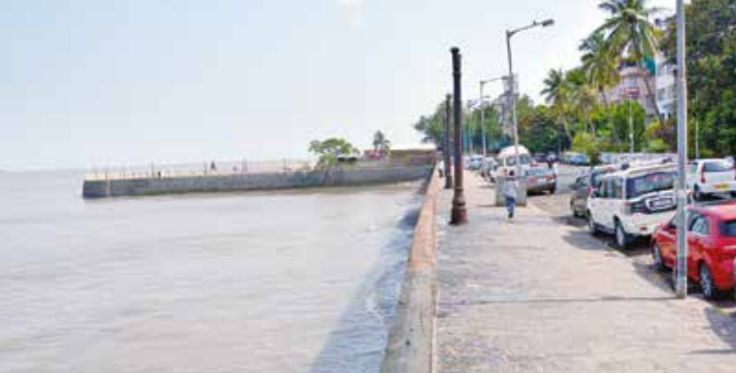
At the point Strand Road greets Henry Road, 1906-built Curzon House is where Scholar School was started in 1960 by Irishwoman MM Grant, the former headmistress of Campion School. Prossers Boarding House here was rented by the Mulchandani family from 1947.
On the facing corner, the 1905 Art Deco jewel Evelyn House extends accommodation to senior marine pilots. It was named after the wife of Arthur Fosberry, chief engineer of the Port Trust (Fosberry himself lent his name to Fosberry House on Mereweather Road just behind). Retired BPT additional chief mechanical engineer Dilip Vishwanathan describes this as the only building on the row with a single flat per level. The architectural expert on Bombay buildings, Foy Nissen, has said, “Evelyn House is on a corner site and forms one of the lynch points of an amalgamated period facade to this unique stretch of Bombay’s harbour waterfront. No other waterfront row of houses has the same character.”
I reach Mark Haven deep in deja vu, recalling cosy Christmas parties with Bombay Local History Society members in Nuvart Mehta’s terrace flat. An Armenian emigre, Nuvart Parseghian from Istanbul was posted to Bombay in 1952 by the USIS education department. Marrying a Parsi colleague, she fiercely cared for the city to the end of her 100 years. “Nuvart was either in Colaba police station or the municipal office every week,” says her close neighbour Gul Kripalani.

David daSilva, grandson of physician Clement Pereira who built Mark Haven, confirms his grandparents named the property after their only son Mark who died young of meningitis. Behind Mark Haven, the apartment block of Joyeden was for their daughters Joyce, Ena and Edna. David’s mother, Edna, married violin virtuoso Vere daSilva, who played in the Dorian Quartet, post-Independence Bombay’s first strings ensemble, with George Lester, Terence Fernandes and Keki Mehta. In 1957, he memorably conducted the Bombay City Orchestra with the African American contralto Marian Anderson at Regal Theatre. “My mother had a memory of the mud track along the water opposite and I was fascinated by a fire hydrant within our garden walls before the 1970s claimed half the grounds for street broadening,” David says.
Breathtaking red champa trees flower at both gates of Belha Court, the sole stone residential structure on the waterfront. They lead to a facade uniquely blending Early Edwardian and Art Deco elements. Ringed by rose gardens, this was Cecily Court till 1938 when it transferred, from an Englishman and his wife Cecily, to the Nawab and Begum of Belha. Their grandson Jaffar Imam, scion of the Kamadhia darbar, explains block to block architectural shifts from Edwardian to Art Deco.
“Driven to St Mary’s School in a 1920s Dodge, I loved the view, the quietude making this street most beautiful,” he says. “The years have brought traffic, beggars and urchins.”
After Belha Court, three hotels loom in a continuous loop. On the patio of Sea Palace Hotel, we watch circling gulls as Srichand Chhabria narrates his father’s story. Doulatram Chhabria purchased the property in 1941 from Gourdon & Co. which ran Silver End Flats, a serviced apartments operation.
Strand Hotel in Kerawalla Chambers presents Art Deco highlights after the comparatively bare walls of Sea Palace. Rustomji Nusserwanji Kerawalla got the building, which has always functioned as a hotel, in 1936, says his namesake great-grandson. From 1960 the top pair of floors is Hotel Harbour View, owned by the Kerawallas. The ground, first and second storeys comprising Strand Hotel belong to Mulchand Lalwani & Associates.
At the cusp of Apollo Bunder and Arthur Bunder Road, 1934-built Shelleys Hotel was Lentin Court, erected by Phirozeshaw Lentin. The ’70s saw it pass to Balwant Rai Selhi (Shelley is the anglicised Punjabi). Then famous as Lentin Court Hotel managed by Otto King, a German who left during the Second World War, the continental-style bed and breakfast was populated by Europeans till 1940. Recent long-staying guests included Rabbi Gavriel Holtzberg, killed in the Nariman House attack of 26/11 and astrologer Bejan Daruwalla, who believed Room Number 8 was lucky for him.
The Bombay Presidency Radio Club ends this strip with a mesmeric pier-embracing-bay location. Five years before the sports club opened, it aired the country’s first broadcast from a low powered station operating on a 387-metre wavelength, in June 1923. This remained the only radio station till All India Radio in 1927.
“In the years we headed to freedom, those news bulletins stirred listeners, made patriots of people,” says Radio Club president, Premal Goragandhi. “We went on to have members turned martyrs.” A resident in Candy Castle nearby, Prem Ramchandani was one of them.
© Meher Marfatia
Multimedia production & digital marketing: Danesh Mistry


It has given me great delight each time I have walked the promenade and the bylanes just to admire these old gems. Your story makes it more endearing in bringing the old residents to fore.
your content has no shelf life ! a benefit which makes a trivia-greedy reader like me..deal with FOMO.. much better...
.... because the every- day- new, nature of digital content, results in FOMO
Congrats and all the best!🥰